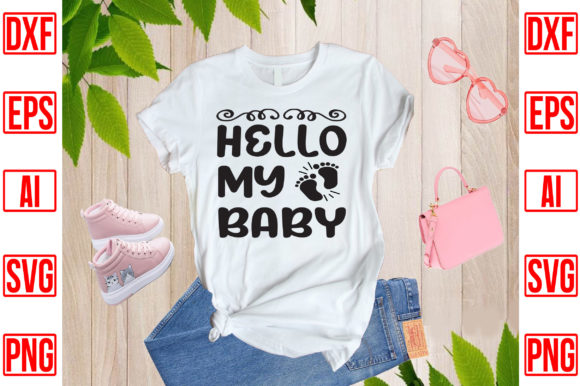
Hello My Baby Graphics for T-Shirt Designs
As a brand designer who’s helped over 80 local businesses refine their visual identity—from artisanal candle studios in Portland to family-run bakeries in Nashville—I recently evaluated Hello My Baby not as clipart, but as a functional graphic design asset for real small business branding. I tested it across packaging, labels, social media graphics, and promotional print—specifically for a new line of organic baby skincare launched by a handmade business in Austin.
A Warm, Handcrafted First Impression—Not Just Cuteness
Hello My Baby lands with gentle confidence: soft curves, balanced negative space, and a subtle hand-drawn texture that reads as warm, approachable, and intentionally human—not mass-produced. It leans feminine without being saccharine, playful without sacrificing polish. For local businesses rooted in care—think boutique baby boutiques, lactation consultants offering branded swaddles, or herbal tea brands launching a “new parent” seasonal line—it suggests authenticity, tenderness, and quiet expertise. It doesn’t scream; it invites. That makes it ideal for premium handmade business positioning—not fast-fashion T-shirt designs, but intentional product labels, gift box accents, and thank-you cards that reinforce emotional resonance.
Where This Graphic Design Asset Earns Its Keep
In the real world of local business branding, Hello My Baby shines where warmth and recognition matter most:
- Product labels & packaging design: Used as a focal illustration on 2 oz amber glass bottles for baby balm, it elevated shelf appeal without competing with ingredient lists—especially when paired with a clean sans serif and muted sage green.
- Brand identity accents: Not as a primary logo (it lacks typographic versatility), but as a supporting element in a full brand system—repeating subtly on tissue paper, hang tags, and reusable cotton bags.
- Social media graphics: The SVG and PNG files scaled beautifully into Instagram Story templates and Pinterest pins for a “New Parent Care Kit” campaign—no pixelation, crisp edges even at small sizes.
- Printable design & promotional materials: Printed flawlessly on kraft thank-you cards and die-cut stickers for local baby fairs. The black-and-white version held richness—critical for cost-effective printing.
- Product mockup integration: Layered cleanly onto mockups of muslin drawstring bags and ceramic jars, reinforcing cohesive visual hierarchy without needing heavy retouching.
What Makes It Work Beyond T-Shirt Designs
This isn’t just another digital product from a creative marketplace. Its file suite—SVG, EPS, AI, DXF, PNG, JPEG—means it functions across disciplines: laser-cut wooden hang tags (DXF), professional label printing (EPS), web design (SVG), and Canva template adaptation (PNG with transparency). That flexibility supports stronger first impressions, clearer visual hierarchy, and more consistent brand identity—especially for small business owners juggling design, production, and marketing alone.
For food businesses adding baby-led weaning pouches to their line, or florists launching a “Welcome Little One” gift collection, Hello My Baby helps bridge product utility and emotional storytelling. Customers don’t just see a label—they feel cared for. That builds trust faster than any tagline.
Where to Use It With Intention—And Where to Pause
Hello My Baby excels in decorative, emotionally driven contexts—but it’s not universally deployable. Use it carefully:
- On very small labels (<2 cm height)—the delicate details soften or vanish. Always test at actual size.
- Alongside dense legal text or ingredient-heavy layouts—its presence can reduce readability if not anchored with ample whitespace.
- Against low-contrast backgrounds (e.g., light gray on off-white)—the PNG’s transparency may blur edges; verify in print proofs.
- In luxury minimalist branding (e.g., high-end apothecary lines)—its warmth may clash with stark monochrome systems unless deliberately softened with tone-on-tone application.
- As a standalone logo for formal corporate branding—it lacks the scalability and typographic integration needed for letterhead or signage systems.
Practical Brand Designer Notes You’ll Actually Use
Before committing to Hello My Baby in your next local business project, run these checks:
- Test it on real packaging mockups—not just screen previews—to assess scale, contrast, and emotional fit.
- Convert to grayscale and invert: Does the silhouette hold? Crucial for embossing, foil stamping, or single-color print runs.
- Preview alongside your brand fonts: It pairs gracefully with rounded sans serifs (like Quicksand) and soft serifs (like Cormorant Garamond), but competes with busy script or tight display fonts.
- Inspect the SVG in Illustrator—check anchor point cleanliness and path simplicity for easy recoloring or resizing.
- Verify commercial licensing: Confirm it permits use on physical goods you sell (e.g., branded onesies, soap labels) and in client work—some marketplaces restrict resale rights.
- Compare against competitor packaging: Does it differentiate—or quietly blend in? In crowded categories like baby products, distinctiveness is non-negotiable.
When used thoughtfully, Hello My Baby does more than decorate—it strengthens product recognition, deepens customer connection, and delivers professional branding without requiring a full design retainer. For the coffee shop adding babyccinos to their menu, the home decor shop launching a nursery collection, or the seasonal pop-up selling handmade baby blankets, it’s not filler. It’s functional warmth—packaged as a versatile, production-ready graphic design asset.